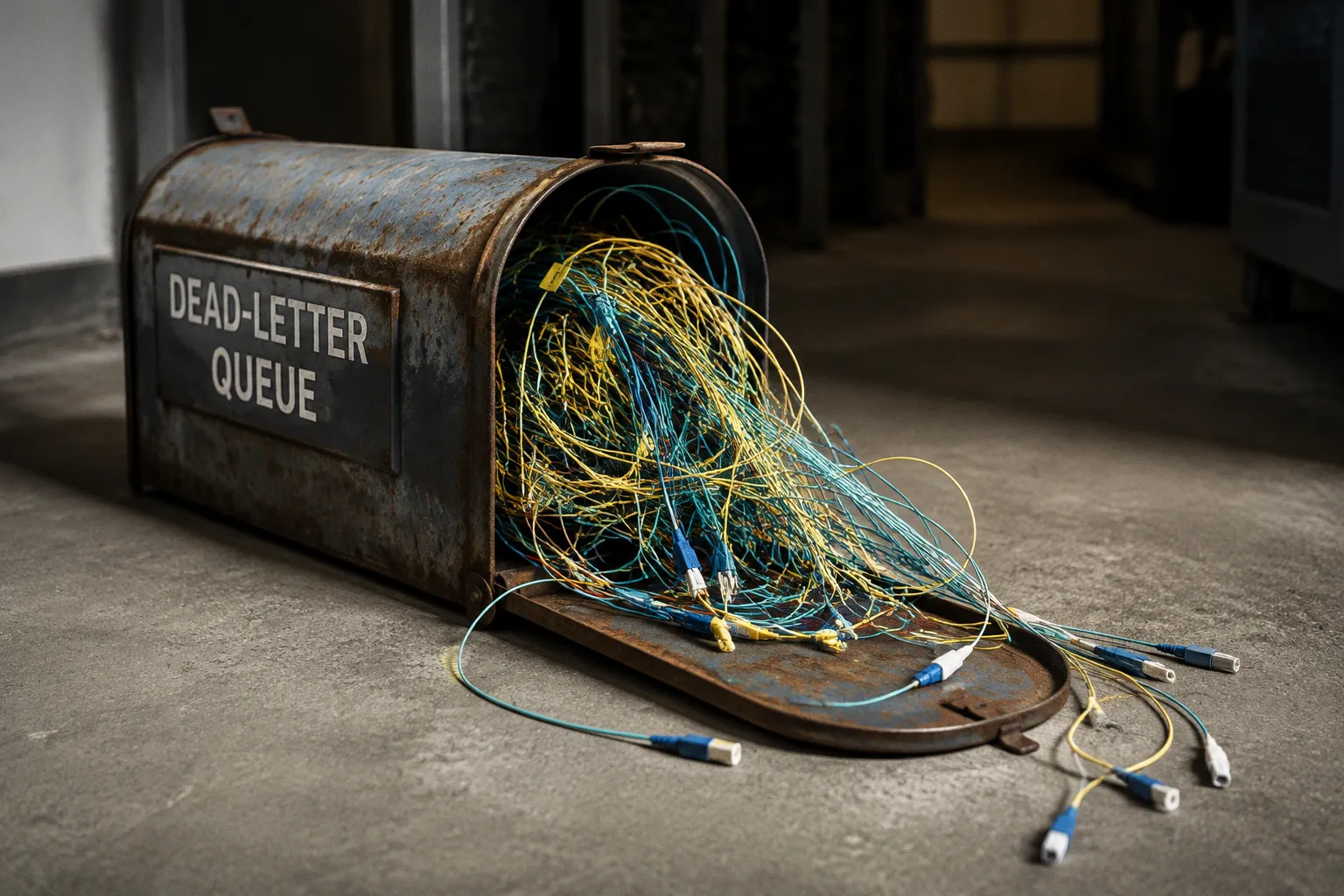
That distinction matters. Most iPaaS workflows already include some form of automated retry logic, but retries are not a recovery strategy by themselves. They are merely a wager that the downstream system will become healthy before the delivery window closes. If the endpoint remains unavailable, returns an unexpected status, exceeds its timeout, or accepts the request while failing to complete the business operation, the event eventually reaches the edge of that wager.
Without a dead letter queue, the payload is commonly left in an error log, an incomplete execution record, or nowhere useful at all. The automation may look operational from the outside while a customer update, payment event, inventory change, or CRM record quietly fails to arrive.
A dead letter queue for iPaaS webhook error handling is the mechanism that turns that silent loss into a controlled operational state: preserve the failed event, retain its metadata, inspect the cause, and replay it only when replay is safe.
The anatomy of a failed webhook: beyond automated retries
A webhook delivery is often described as a simple exchange:
1. One system emits an event.
2. An iPaaS platform receives it.
3. The platform invokes a workflow.
4. The workflow writes to another system.
That description is structurally correct and operationally incomplete. Each stage has its own failure modes, and the failure may occur after the receiving system has already performed part of the requested work.
Consider a workflow that receives a payment event, creates an order in a database, updates a customer record, and sends a notification. A timeout at the notification step does not necessarily mean that the order was not created. A 500 response from a downstream API does not prove that the API rejected the request; the remote service may have committed the transaction and failed while forming its response. A connection reset may leave the sender with no knowledge of whether the receiver processed the payload.
This is why a dead letter queue is not just a bin for bad JSON. It is a record of an uncertain distributed transaction.
What belongs in a DLQ record
A useful dead letter queue entry should preserve more than the original webhook body. At minimum, the record should retain:
- The complete source payload, preferably in its original form.
- The event identifier supplied by the sender.
- The idempotency key used by the receiver.
- The source system and webhook endpoint.
- The timestamp of the original event and each delivery attempt.
- The HTTP status code or transport error.
- The number of retry attempts already consumed.
- The workflow version or route that attempted processing.
- The step at which execution failed.
- The relevant response body, with secrets and personal data redacted.
- The current replay status and operator notes.
This metadata is not decorative. Without it, the team cannot distinguish a malformed payload from an expired credential, a rate limit, a schema mismatch, or a temporary outage. A queue that stores only the body is not a recovery system; it is an evidence locker with the labels removed.
A dead letter queue does not make a workflow reliable by itself. It makes failure observable, recoverable, and accountable.
The retry boundary
Retries should be treated as a bounded phase before quarantine, not as an infinite attempt to force a broken dependency into compliance.
Stedi, for example, retries webhook events associated with non-2xx responses up to four times, waiting 90 seconds between attempts, before moving the event to an error queue. The exact policy differs by platform and provider, but the architectural pattern is consistent: delivery is attempted, transient failure is given a defined recovery window, and exhausted events are routed somewhere that humans or software can handle deliberately.
Provider behavior can vary substantially:
| Provider or platform | Failure behavior described in the available documentation | Architectural implication |
|---|---|---|
| Stedi | Up to four retries for non-2xx responses, with a 90-second interval; exhausted events move to an error queue | The receiving workflow needs a durable inspection and replay path after the retry budget ends |
| Stripe | Failed webhook deliveries may be retried for up to 72 hours using exponential backoff | A temporary outage may recover automatically, but the system still needs reconciliation and duplicate protection |
| GitHub | Failed deliveries may be retried for up to three days | The consumer must remain idempotent across a long retry horizon |
| Slack | Expects an HTTP response within three seconds | A slow synchronous workflow should be separated from the acknowledgement path |
| Make | Incomplete executions can be retained when enabled | The incomplete-execution area can function as a manual recovery queue, but it is not automatically equivalent to a full DLQ |
| Zapier | Error handling steps can run custom responses instead of allowing automatic replay behavior | The error path must be designed explicitly rather than assumed from the default Zap behavior |
The critical point is not which provider retries for the longest period. Long retry windows are useful, but they do not remove the need for durable failure handling. They can even increase the period during which duplicate or out-of-order events remain possible.
Platform-specific error handling: Make incomplete executions and Zapier error paths
The phrase “DLQ implementation in Make and Zapier” can be misleading because neither platform should be casually described as providing an enterprise message queue equivalent to Kafka or Amazon SQS in every configuration. Their native failure mechanisms are useful, but their guarantees depend on the workflow design, retention behavior, available history, and the way the operator handles replay.
The right question is not whether a platform has a button labelled “dead letter queue.” The right question is whether the workflow can preserve failed events, expose the reason for failure, prevent unsafe automatic duplication, and support controlled reprocessing.
Make: incomplete executions as a manual recovery queue
In Make, enabling incomplete executions changes the failure path. When a scenario encounters an error, execution stops and the record is moved to the incomplete executions area rather than simply vanishing into a generic run history. This is a valuable operational feature because it gives the team a concrete unit of work to inspect and resume.
But an incomplete execution is not automatically a well-designed DLQ.
The distinction becomes important when a scenario contains several side effects. Suppose the workflow has already created a record in a billing system and then fails during a database synchronization step. Resuming the incomplete execution from the wrong module can create a second billing record. Resuming from the beginning can replay every earlier action. Treating the entire scenario as an indivisible transaction is convenient in the visual editor and false in the distributed system underneath.
A more disciplined Make design separates:
1. Ingress — receive and validate the webhook.
2. Normalization — convert the provider-specific payload into an internal event shape.
3. Deduplication — verify whether the event or idempotency key has already been processed.
4. Business actions — perform writes and external side effects.
5. Failure capture — record the payload and execution context.
6. Replay — re-enter the workflow at a safe boundary.
The replay boundary should be explicit. If the failed step is a CRM update, the recovery operation should not blindly repeat the preceding payment capture or order creation. That may require splitting a bloated scenario into smaller scenarios or introducing a durable state record that tracks which side effects have completed.
Zapier: error paths are not a substitute for durable state
Zapier’s error handling steps, launched in beta on February 28, 2024, allow a Zap to execute custom response steps when an error occurs. Adding an error handler prevents the Zap from automatically replaying in the ordinary way when an error happens, giving the workflow an opportunity to notify an operator, write a record, or route the failure into another system.
That is a powerful control point, but it introduces a responsibility that the default retry path can obscure: the error handler must actually preserve enough information for recovery.
A weak error path sends a notification containing the phrase “Zap failed.” A useful error path writes a structured failure record containing the source event, the action that failed, the error response, the execution identifier, and a replay status. The difference is the difference between alerting and operations.
For a serious workflow, the handler should write to a durable store rather than relying exclusively on email or transient task history. A table in a database, a dedicated data store, or a purpose-built incident queue can hold the event and its state. The exact storage technology is less important than the properties:
- The record survives beyond the immediate task history.
- Operators can search by event ID, customer ID, or failure class.
- Replay status is explicit.
- A successful replay cannot be accidentally launched twice by two operators.
- Sensitive data is protected according to the business requirement.
Error routing should classify, not merely redirect
An ip aas error routing workflow should not send every exception to one undifferentiated destination. At least three broad classes deserve different handling:
- Transient failures: rate limits, temporary service unavailability, network interruptions, and gateway errors. These may be retried after a delay.
- Permanent input failures: invalid schema, missing required fields, unsupported event types, and authentication failures caused by invalid configuration. These should usually be quarantined until the underlying defect is corrected.
- Ambiguous side-effect failures: timeouts or connection resets after a request may have reached the downstream service. These require idempotency checks and reconciliation before replay.
This classification can be implemented through status codes, provider error types, step metadata, and explicit workflow branches. It should not depend on an operator inferring the entire story from a red icon in a run history.
Designing for idempotency: the condition that makes replay safe
A dead letter queue without idempotency is a mechanism for repeating mistakes with better visibility.
Every webhook event that can trigger a side effect should carry a stable identifier. The sender may provide an event ID, or the integration can derive a stable idempotency key from a UUID tied to the source event. The receiving system must store that key and verify it before executing business logic.
The sequence should look conceptually like this:
1. Receive the webhook.
2. Extract the stable event or idempotency key.
3. Check whether the key has already been processed.
4. If it has, return a safe success response or follow the provider-specific duplicate policy.
5. If it has not, reserve or record the key.
6. Execute the business operation.
7. Mark the event as completed, or record the failure state for recovery.
The reservation step deserves particular care. A naïve implementation checks for an existing key and then performs the side effect, leaving a race between two concurrent deliveries. Two workers can both observe that the key is absent and both proceed. A durable datastore should enforce uniqueness at the storage layer where possible, rather than trusting a visual conditional branch to provide concurrency control.
Idempotency is not the same as deduplication
Deduplication usually means recognizing that the same event appeared more than once. Idempotency means that repeating the operation does not create an incorrect result.
For a database insert, uniqueness on the source event ID may prevent duplicate rows. For an update, applying the same state transition twice may already be harmless. For an email, a duplicate-send problem is more difficult: the provider may not offer a meaningful idempotency key, and the message may already have left the system before the timeout occurred. For a payment or fulfillment action, replay may require a provider-side idempotency mechanism and a reconciliation query before any new request is submitted.
This is why the receiver should maintain a processing ledger rather than relying only on the webhook platform’s task history. The ledger can represent states such as:
receivedprocessingcompletedfailed_transientfailed_permanentreplay_pendingreplayedrequires_review
The state model need not be elaborate, but it must express uncertainty. A binary success/failure flag is too crude for distributed operations where the remote system may have committed a change while the local workflow reported an error.
Replay is safe only when the business operation is idempotent or the system can first determine whether the original side effect already happened.
Strategic backoff and timeout management in modern iPaaS
Retry logic is often configured as if every failure has the same meaning. That produces brittle systems: they hammer a rate-limited API, retry malformed requests, and wait too long for endpoints that have strict response deadlines.
Timeouts are architectural constraints, not minor configuration details.
Stedi counts a webhook delivery as failed if the endpoint does not respond within five seconds. Slack expects an HTTP response within three seconds. A workflow that performs several database writes, calls an external API, waits for a browser automation step, and then attempts to acknowledge the webhook is not merely slow. It is violating the contract of the ingress channel.
The robust pattern is to acknowledge quickly and process asynchronously where the provider permits it:
1. Validate enough of the request to reject obviously malformed input.
2. Persist the event durably.
3. Return the expected success response within the provider’s time limit.
4. Process the event from the durable record.
5. Retry or quarantine the work independently of the original HTTP exchange.
This design prevents the webhook sender from mistaking internal processing time for delivery failure. It also creates a proper place to apply backoff, rate limits, circuit breaking, and replay controls.
Exponential backoff is not a universal cure
Exponential backoff is appropriate for many transient failures, particularly where the remote service signals rate limiting or temporary unavailability. It is not appropriate for every response.
A malformed payload will not become valid because the workflow waited longer. An expired API credential will not repair itself through repetition. A permanent authorization failure can generate a storm of retries that obscures the real incident.
A practical retry policy should answer four questions:
- Which error classes are retryable?
- How many attempts are allowed?
- What is the maximum elapsed retry window?
- Where does the event go after the retry budget is exhausted?
That final question is the one that separates a resilient integration from an optimistic script. Exhaustion must have a defined destination: an error queue, a durable failure table, an incomplete execution record, or a controlled incident workflow.
Building a custom DLQ pattern for production-grade workflows
When the native iPaaS error features are insufficient, a custom dead letter queue can be implemented without building an entire messaging platform. The design should remain narrow and deliberate. The goal is not to recreate Kafka inside a low-code scenario builder. The goal is to create durable failure handling around the workflows that can materially affect the business.
The minimum viable architecture
A production-grade custom pattern commonly contains five pieces:
1. Ingress storage
Persist the webhook payload and source metadata before performing non-trivial work.
2. Processing ledger
Store the event ID, idempotency key, current state, attempt count, and timestamps.
3. Execution workflow
Consume pending events and perform normalization, validation, and business actions.
4. Failure route
On exhausted retries or non-retryable errors, write the complete failure context to the DLQ record.
5. Replay controller
Allow an operator or scheduled process to requeue eligible events after the cause is understood.
The replay controller should not simply flip every failed row back to pending. It should enforce policy. An operator may need to select a safe starting step, update a corrected field mapping, confirm that credentials are valid, or mark an event as intentionally abandoned. Replay is a business operation, not a button to be pressed until the red status turns green.
A durable DLQ schema
A compact table might include fields such as:
| Field | Purpose |
|---|---|
event_id | Stable identifier from the source provider |
idempotency_key | Key used to prevent duplicate side effects |
payload | Original webhook body, stored with appropriate protection |
source | Provider, endpoint, or integration route |
workflow_version | Version that attempted processing |
status | Current lifecycle state |
attempt_count | Number of delivery or processing attempts |
last_error_class | Transient, permanent, or ambiguous side-effect failure |
last_error_detail | Sanitized response or exception context |
next_attempt_at | Scheduled retry or replay time |
completed_steps | Side effects already confirmed |
created_at and updated_at | Operational timestamps |
operator_note | Human context for manual review |
The completed_steps field is especially useful in workflows that cannot be made fully atomic. It lets recovery logic distinguish between “nothing happened” and “the customer record was updated, but the notification failed.” Without this information, the replay code is forced to guess.
Manual replay versus automatic replay
Automatic replay is appropriate for failures that are demonstrably transient and for operations with reliable idempotency. Manual replay is preferable when:
- The error indicates a schema or mapping defect.
- A credential or permission has changed.
- The downstream operation may already have succeeded.
- The event is commercially sensitive.
- The workflow version has changed since the original attempt.
- Replaying could trigger external communication or financial action.
A good system can support both without conflating them. Automatic retries should consume a bounded budget. After that, the event should enter a visible queue with a reason and a recommended next action.
Observability is part of the queue
A queue that nobody watches is still a silent failure mechanism, only slower.
Operational metrics should expose at least:
- Number of events entering the DLQ.
- Oldest unprocessed event age.
- Failure rate by source and workflow.
- Failure rate by error class.
- Replay success and failure counts.
- Events approaching retention limits.
- Events stuck in
processing. - Duplicate attempts detected by idempotency checks.
The exact dashboard tooling is secondary. The important property is that the team can detect accumulation before a queue becomes a graveyard of unresolved business transactions.
Retention also needs an explicit policy. There is no universal maximum storage period across iPaaS vendors, and pricing for retained execution logs or error queues varies. Payloads may contain personal, financial, or operationally sensitive data, so indefinite retention is not automatically a virtue. Keep enough history to support the business recovery window, audit needs, and incident investigation; delete or redact what no longer has a legitimate purpose.
The architectural mandate
A failed webhook is not an edge case when the workflow sits between payment systems, customer records, fulfillment, analytics, and internal operations. It is a normal state in a distributed system.
The correct response is not to add more retries until the platform stops complaining. It is to design a failure lifecycle:
- acknowledge within the provider’s timeout contract;
- persist the event before expensive processing;
- classify errors rather than retrying indiscriminately;
- apply bounded backoff;
- enforce stable idempotency keys;
- record which side effects completed;
- quarantine exhausted events in a durable dead letter queue;
- replay only from a controlled boundary;
- measure the queue as an operational system.
Make incomplete executions and Zapier error handling steps can provide useful foundations, but they do not absolve the architect from designing state, deduplication, and replay semantics. Native platform features are building blocks, not guarantees.
The strict best-practice mandate is therefore simple: every webhook workflow that can create, modify, charge, notify, or delete business data must have an explicit exhausted-failure path. If the design cannot answer where a failed event goes, how its original payload is preserved, and how replay avoids duplicate side effects, the workflow is not production-grade. It is merely fortunate so far.