Headless vs Full-Stack No-Code Web Apps: Architecture Trade-offs
The first version may launch, the interface may look polished, and the database may hold together neatly—yet every new channel, integration, or permission rule can expose the cost of the structure chosen at the beginning.
This is the practical question behind headless no-code vs full-stack web apps. A full-stack no-code platform keeps the database, backend workflows, frontend, and administration in one connected environment. A headless approach separates the backend services from the user-facing interface and connects them through APIs. Neither model is automatically more modern, scalable, or economical. They solve different problems.
For a business building a client portal, internal dashboard, responsive web application, or early-stage SaaS product, the decision is less about choosing the most sophisticated architecture and more about choosing the amount of separation the product can genuinely use.
The structural divide: one environment or several coordinated layers
The clearest way to understand the difference is to look at where the application’s responsibilities live.
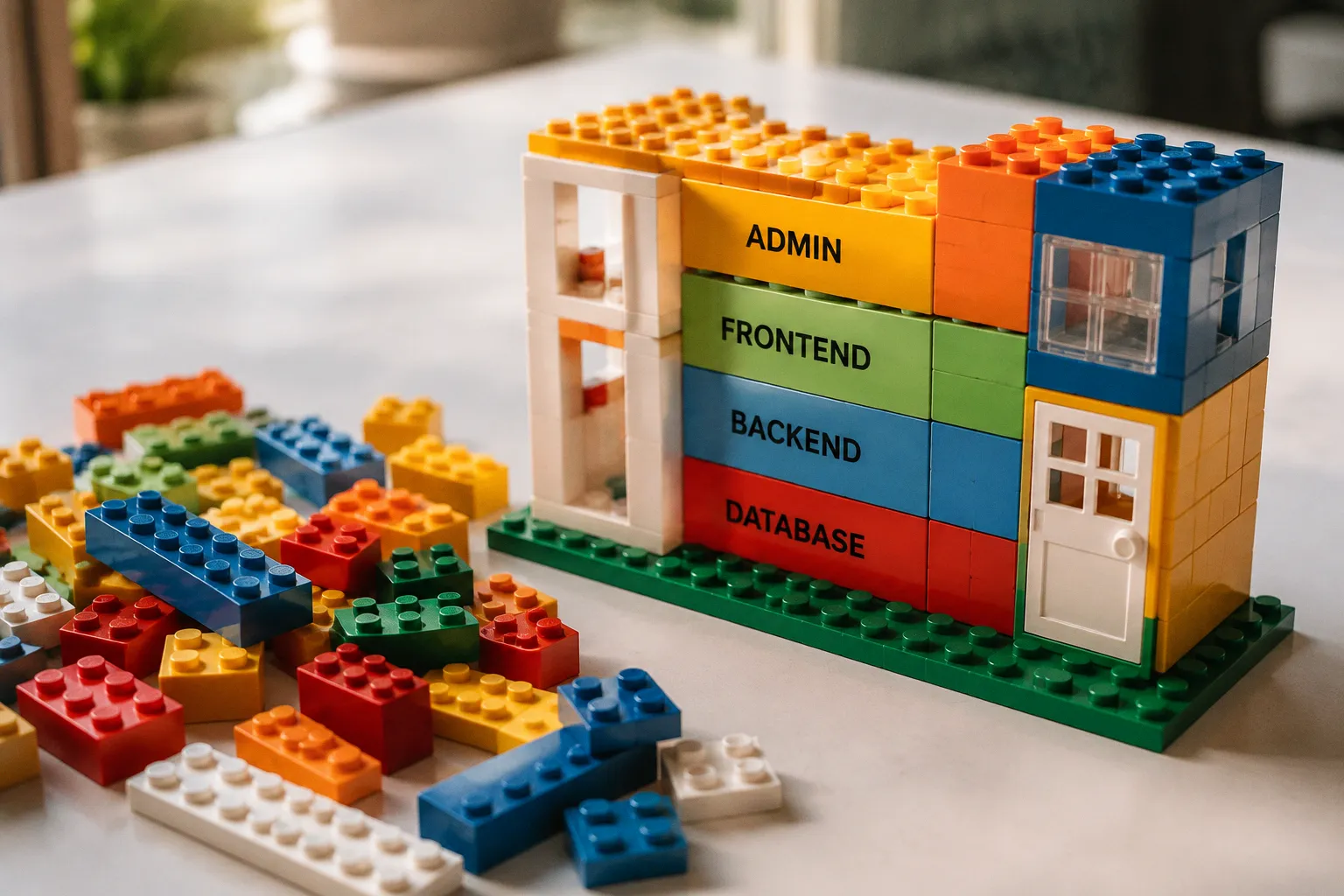
A full-stack no-code platform brings most of the application into a single system:
- The database stores business records.
- Backend workflows handle rules, notifications, and scheduled actions.
- The frontend presents those records to employees, customers, or administrators.
- Authentication, permissions, and administration are usually configured inside the same platform.
- Deployment is managed through one primary environment.
That integration is not a shortcut in the dismissive sense. It is an architectural decision that reduces the number of boundaries a team has to manage. When a user submits a form, the interface, workflow logic, and database are often part of the same platform model. A change can move from idea to working feature without requiring a separate frontend repository, backend service, API gateway, and deployment pipeline.
A headless architecture takes a different approach. The backend becomes the source of data and business capabilities, while the frontend is built separately and communicates with that backend through APIs. The visual layer might be a custom web application, a mobile application, or several different interfaces. Content and records can be delivered to each one without rebuilding the underlying system.
This creates flexibility, but also introduces coordination work. The API becomes a formal contract between systems. Authentication must work across the boundary. Data models need to support the requirements of every connected interface. Error handling, versioning, testing, monitoring, and deployment are no longer contained within one environment.
The phrase “headless” therefore describes a separation of responsibilities, not the absence of a frontend. There is still a frontend; it simply does not live inside the same tightly coupled platform as the backend.
Full-stack no-code reduces the number of architectural boundaries. Headless architecture gives you more control over those boundaries, but it also makes you responsible for them.
That distinction matters when comparing a separated backend versus an all-in-one no-code system. A unified platform often enables a smaller team to build and operate a complete application with fewer moving parts. A decoupled system can support more presentation channels and more specialized interfaces, but it asks the team to design the connections deliberately.
Time-to-market: where full-stack platforms create their strongest advantage
For many custom web projects, the first deadline is not a technical one. It is operational: when can the sales team use the portal, when can clients see their project status, or when can staff stop copying information between spreadsheets and email?
Full-stack no-code approaches are usually strongest when the business needs a functional MVP quickly and the initial product is primarily a web application. The collected benchmarks in this comparison place typical MVP delivery at roughly 2 to 6 weeks for full-stack approaches. Headless setups are estimated at 8 to 16 weeks, while composable approaches commonly fall between 6 and 12 weeks.
These ranges are not promises, and they do not measure the same thing in every project. A simple headless application with an existing backend and a narrowly defined frontend could move faster than a complicated full-stack build. Conversely, a full-stack portal with difficult permission logic, third-party integrations, and complex reporting can take considerably longer than a basic MVP.
Still, the difference in default delivery speed is meaningful. Full-stack platforms remove several early decisions:
- Which API style should the application use?
- How will authentication tokens be managed?
- How will frontend and backend deployments be coordinated?
- Which system owns validation rules?
- How should API failures appear in the interface?
- How will changes to the data model affect connected clients?
These questions do not disappear in a headless project. They arrive earlier, often before the business has learned enough from real users to answer them confidently.
For a new custom web application, that sequencing can be costly. A team may spend weeks designing flexibility for mobile apps, partner integrations, or future channels that may never become part of the product. Full-stack no-code provides a way to validate the workflow first. It can enable the team to learn which screens, roles, automations, and records actually matter before committing to a more distributed system.
Where the time difference becomes less decisive
Speed is not only about how quickly the first version launches. It also concerns the shape of later changes.
A full-stack platform can accelerate the first release, but a tightly coupled application may become harder to reshape if the frontend, backend, and database assumptions have grown together. A headless architecture may take longer to establish, yet make certain later changes more manageable because the frontend is not tied to the backend’s presentation layer.
The real question is not simply whether the MVP can launch in six weeks or twelve. It is whether the architecture supports the next stage without forcing an expensive reconstruction.
A useful distinction is:
1. Learning speed — how quickly the team can test the business workflow with real users.
2. Feature speed — how quickly the team can add functionality after launch.
3. Channel speed — how quickly the same business capability can appear in another interface.
4. Change speed — how safely the system can evolve when the original assumptions prove incomplete.
Full-stack no-code is often excellent at the first two when the product is web-first. Headless architecture becomes more compelling when channel speed and independent frontend change are central to the business model.
The financial reality: initial cost is only one part of the architecture decision
The cost difference between these approaches can be substantial. The available benchmarks place typical upfront implementation costs for full-stack no-code projects at approximately US$5,000 to US$30,000. Headless implementations can range from around US$50,000 to more than US$200,000, while headless CMS setups are also described in the range of US$15,000 to US$60,000 or more for upfront development.
Those ranges should be read as directional rather than universal price lists. Scope, design quality, data migration, integrations, security requirements, and the experience of the delivery team can change the result considerably. A narrow headless implementation may cost less than a broad full-stack application. The architecture itself does not determine the entire budget.
It does, however, affect where the budget goes.
| Cost area | Full-stack no-code | Headless architecture |
|---|---|---|
| Initial build | Lower in many MVP and internal application scenarios | Higher because backend and frontend layers must be coordinated |
| Frontend flexibility | Constrained by the platform’s visual and runtime model | Greater control over frontend behavior, performance, and interaction design |
| API design | Often abstracted or handled inside the platform | A central engineering responsibility |
| Deployment | Usually concentrated in one platform | Distributed across backend, frontend, and supporting services |
| Maintenance | Fewer systems to monitor, but more platform dependence | More independent parts to maintain, with greater separation |
| Multi-channel delivery | May require additional application work | Natural fit for web, mobile, and other connected interfaces |
| Migration risk | Potentially significant if platform assumptions become limiting | Potentially significant if APIs, data models, or services are poorly designed |
| Long-term TCO | Often lower for contained applications | Can be justified when reuse and channel scale offset additional complexity |
The phrase “total cost of ownership” is useful here because the cheapest initial build is not always the least expensive system to operate. A full-stack application may keep costs low while the workflow remains contained in one responsive web interface. If the business later needs a mobile app, a partner-facing API, and a separate customer portal, the original platform may become less comfortable to extend.
Headless systems carry more cost at the beginning because they establish reusable backend services and explicit interfaces. That investment may be sensible when several products will rely on the same data or when the frontend needs to change independently. It may be difficult to justify when one small team needs a single internal application and has no confirmed second channel.
Two-year TCO estimates in the available research place smaller no-code implementations in the range of approximately US$500 to US$5,000, rising to around US$15,000 to US$40,000 when migration is included. Comparable headless estimates are described at roughly US$15,000 to US$40,000 for mid-size implementations and US$30,000 to more than US$100,000 for enterprise scenarios. These figures are broad, and they should not be treated as a substitute for project-level modeling. Their value is in showing the pattern: distributed architecture tends to require more financial commitment before its reuse and flexibility begin to pay back.
Headless architecture earns its complexity through reuse
The strongest argument for headless systems is not that they are inherently faster. It is that they allow one backend to serve several experiences.
A centralized backend can deliver business data or content to:
- A public website.
- A customer portal.
- An internal operations dashboard.
- A mobile application.
- A partner interface.
- A smartwatch or other specialized device.
- Emerging environments such as AR, VR, or IoT applications.
This multi-channel capability is one of the defining operational advantages of headless architecture. The business rules and records can remain in a central system while each channel presents them in a form suited to its users.
For example, a logistics company might need an internal dispatch dashboard, a customer shipment portal, and a mobile application for drivers. A single backend could coordinate shipment records, status changes, user permissions, and notifications. Each interface would have its own requirements, but they would not need to recreate the underlying operational model independently.
The same pattern can serve a SaaS business with different surfaces for administrators, account owners, end users, and integration partners. In that environment, frontend separation can enable specialized experiences without duplicating core business logic.
But reuse only creates value when reuse is real. A backend designed for three future applications is not automatically an asset if the business eventually launches only one. The team has paid for flexibility without receiving its benefit.
The API becomes a product surface
In a headless system, the API is not merely plumbing. It becomes one of the principal ways the business exposes its data and capabilities.
That means the API needs clear decisions around:
- Which records can be read or changed.
- How user roles affect access.
- How validation rules are enforced.
- What happens when a request fails.
- How records are filtered, sorted, and paginated.
- How changes are introduced without breaking existing clients.
- Which operations are safe to repeat.
- How activity is logged for support and compliance needs.
No-code tooling can accelerate parts of this work, but it does not remove the need for API design. A headless no-code project still needs a coherent data model and dependable rules for communication between systems. Treating the API as an afterthought simply moves complexity from the visual builder into production support.
This is where some teams misjudge the architecture. They see a headless backend as a clean way to separate the application, but underestimate the work required to make that separation reliable. The frontend and backend may be visually independent, yet the product still depends on the quality of their contract.
Full-stack no-code is not a compromise when the product is contained
There is a tendency to describe all-in-one platforms as temporary solutions, as though serious software must eventually be rebuilt into a more separated architecture. That is an unhelpful assumption.
A full-stack no-code application can be the right long-term system when:
- The product is primarily browser-based.
- One organization controls the main workflow.
- The number of user roles is manageable.
- The interface does not need deep platform-specific customization.
- The database and business rules are unlikely to serve several independent products.
- The team values a shorter path from change request to deployed feature.
- The people maintaining the system are closer to business operations than to software infrastructure.
In these conditions, integration is an advantage. One environment can make the application easier to understand, easier to hand over, and easier to troubleshoot. A manager can see how the workflow, records, and interface relate without tracing a request across multiple services.
That simplicity also has a human dimension. The system will be maintained by real people after the original build is complete. If the architecture requires several specialist roles for routine changes, the business may lose the practical benefit of no-code development. A platform that allows an operations team to safely adjust a status flow or add a field can be more valuable than a technically elegant system that turns every small change into a development project.
There are, of course, boundaries. Full-stack platforms can become uncomfortable when the application needs highly distinctive frontend behavior, advanced performance tuning, numerous external consumers, or independent release cycles for multiple interfaces. The platform may still support the requirements, but the team should test those boundaries early rather than assume that visual configuration will cover every case.
A decision framework for custom web application architecture
The most reliable choice begins with the product’s operating model, not with a preference for a particular architecture.
Ask the following questions in order.
1. How many interfaces are genuinely required?
If the immediate product is one responsive web application, full-stack no-code deserves a strong presumption. If the same operational data must support a web portal, a mobile app, and partner integrations, headless architecture has a clearer rationale.
Do not count hypothetical channels as current requirements. A future possibility can be recorded as an architectural constraint, but it should not automatically drive the entire first build.
2. Which parts of the system must change independently?
Headless architecture is valuable when the frontend needs to evolve without changing backend services, or when multiple interfaces need different release schedules. If the user experience and backend workflow will be designed, tested, and released together, the benefit of separation may be limited.
3. Is the data model stable enough to become a shared service?
A backend reused by several applications needs more than a collection of tables. It needs stable definitions for records, permissions, validation, and operations. If the business model is still changing weekly, a tightly coordinated full-stack MVP may provide better learning speed before the backend becomes a shared contract.
4. Who will operate the application after launch?
Architecture should match the team that owns the system. A full-stack environment may be easier for business-led teams to maintain. A headless setup can work well with an internal product and engineering function that is prepared to monitor services, manage API changes, and support multiple deployment paths.
5. What kind of failure can the business absorb?
A unified application concentrates dependency in one platform, while a headless system distributes dependency across several services and interfaces. Neither arrangement eliminates failure. They change its shape.
With full-stack no-code, a platform limitation or vendor change may affect several parts of the application at once. With headless architecture, an API outage, authentication problem, or incompatible deployment can interrupt communication between otherwise functioning components.
The right question is not which model has no risk. It is which risk the business can identify, monitor, and respond to.
Choose headless when separation will be used repeatedly. Choose full-stack when integration will remove work your team does not need to perform.
A practical route for teams that are still deciding
The choice does not have to be framed as a permanent battle between two camps. A sensible project can use the first stage to discover whether separation is justified.
One workable path is to begin by mapping the core business capabilities:
1. Define the records that the application owns, such as accounts, projects, orders, cases, or subscriptions.
2. Separate business rules from presentation details so the team can see which logic might later be reused.
3. List the interfaces required at launch, then distinguish committed channels from possible future channels.
4. Model permissions early, particularly where customers, employees, partners, and administrators see different data.
5. Estimate the cost of operating each architecture, not just the cost of building it.
6. Identify the first likely migration boundary if the business outgrows the chosen platform.
This process often reveals that the decision is narrower than it first appears. A business may not need a fully headless application; it may need a full-stack web app with a small number of carefully designed integration points. Another business may discover that the customer portal and mobile experience are already central to the product, making a decoupled backend a reasonable early investment.
The key is to avoid creating accidental architecture. A full-stack application should not become a collection of improvised workarounds because the team never defined its limits. A headless application should not become a distributed system simply because separation sounded more future-proof.
The measured choice
The comparison between headless no-code and full-stack web apps is ultimately a comparison between two kinds of discipline.
Full-stack no-code asks the team to accept a more integrated environment in exchange for speed, lower initial complexity, and a shorter path to a working web application. It is often the stronger choice for contained workflows, internal tools, client portals, and early SaaS products where learning from users matters more than serving every possible channel from the first release.
Headless architecture asks the team to invest earlier in explicit boundaries, APIs, and independent interfaces. In return, it can enable multi-channel delivery, reusable backend capabilities, and greater freedom in frontend design. Its value grows when the business has several real consumers of the same data and when those consumers need to evolve independently.
The best architecture is therefore not the one with the most layers. It is the one that gives the business enough structure for its next stage without charging it for complexity it has not yet earned.
Start with the workflow, the users, and the channels that genuinely exist. Then choose the smallest architecture that can support them cleanly—and leave a deliberate path for separation if the product’s future begins to make that investment worthwhile.