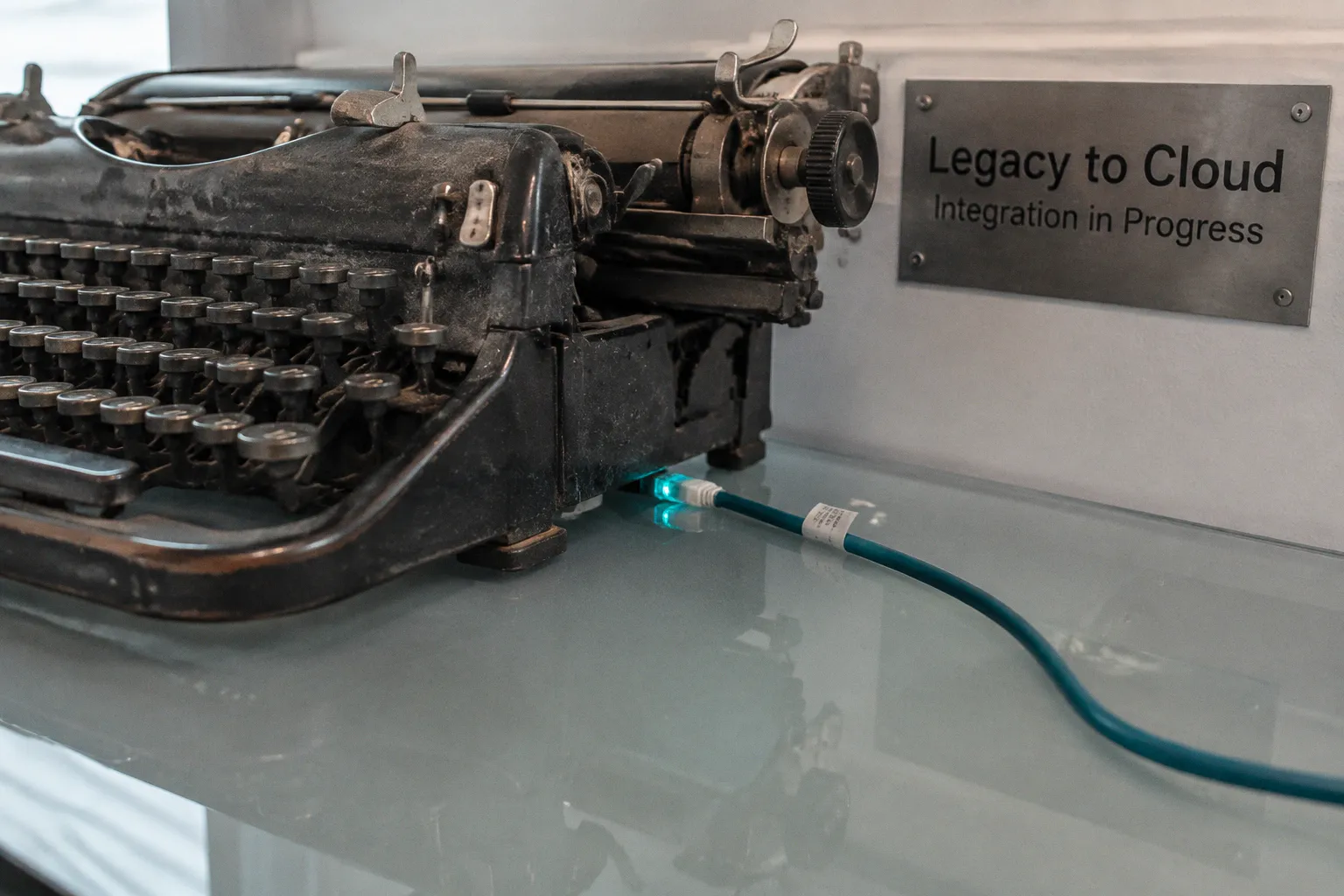
The Real Numbers on Your Legacy Stack
Just keeping the lights on. Multiply that across a mid-sized enterprise with dozens of aging systems, and the overhead starts to look like a separate line of business—one that produces nothing.
The U.S. government, per a 2026 GAO report, spends roughly 80% of its IT budget on legacy system maintenance. Not new capabilities. Maintenance. Seventy percent of Fortune 500 companies still operate software older than two decades. The stack is not just aging. It is calcified.
You are not running a software estate. You are running an upkeep operation that occasionally ships a feature.
This is the part that rarely makes it into board decks. Legacy is not a technical problem. It is a recurring cost line with no ROI, dressed up as an IT line item.
Mapping Dependencies Before You Touch Anything
The first move in any modernization effort is dependency mapping. Not the kind of dependency diagram you draw once and forget. A live, audited map of every system, database, batch job, and human process that touches the legacy core.
Two-decade-old stacks accumulate undocumented integrations. Spreadsheets pulling data via ODBC. Cron jobs running COBOL programs at 2 a.m. Vendor screens scraping green-bar terminals. These are the actual bottlenecks when you start replacing components, and they will not surface in any architecture document you inherited.
The goal at this stage is exposure, not replacement. Wrap the legacy database and transactional core with REST APIs. Low-code platforms are well-suited for this step because the connector logic—schema translation, authentication, response shaping—can be built and revised without touching the mainframe code itself. You are not modernizing the legacy core. You are making it addressable from modern systems.
What you end up with is an API surface that sits in front of a system you do not need to rewrite yet. The legacy core continues to run. The new surface speaks modern protocols. AI tools, dashboards, and customer-facing apps can consume the data through HTTP calls instead of screen-scraping.
This is unglamorous work. It is also the only foundation that makes incremental migration possible. Skip it and the next phase is guesswork.
The Strangler Fig Pattern: Incremental Replacement That Actually Works
The "rip and replace" approach fails for a predictable reason: every rewrite underestimates the integration surface. The replacement goes live. Three weeks later, the operations team discovers that the new system cannot talk to the inventory batch job that has been running unattended since 2004. Rollback. Budget overrun. Postmortem with the word "lessons learned" in the title.
Low-code modernization avoids this by adopting the strangler fig pattern. The name comes from the vine that slowly replaces a host tree. The mechanism in software:
1. Place an API gateway or reverse proxy in front of the legacy system.
2. Route one specific module—say, customer onboarding—to a new low-code service.
3. Run both systems in parallel.
4. Validate outputs match against the legacy baseline.
5. Shift traffic permanently to the new module.
6. Repeat for the next module.
The legacy core shrinks in slices, not in one catastrophic cutover. Each slice is a contained project with a defined scope, a measurable cost, and a rollback path. The risk profile drops from "replace a 2-million-line ERP" to "migrate a single workflow in six weeks."
Big-bang rewrites are where modernization budgets go to die. Strangler fig is where they actually deliver.
The point is not speed. The point is keeping the lights on while you replace the wiring.
The COBOL Talent Cliff Is Already Here
Here is a number that does not get enough airtime in procurement discussions: the COBOL developer workforce shrinks by 10–15% annually. Meanwhile, over 220 billion lines of COBOL code remain in active enterprise use across financial services, insurance, healthcare, and government.
Japan has named this the "2035 Cliff"—the projected date when the mainframe talent pool collapses below operational viability. The U.S. is on the same trajectory, just without the marketing label and with the same demographic math.
Low-code does not eliminate the need for COBOL expertise. Anyone claiming otherwise is selling you something. What it does is reduce the blast radius of that shrinking talent pool. Once the legacy core is wrapped in APIs and exposed as services, the day-to-day maintenance surface shrinks. The remaining COBOL engineers focus on the transactional engine. Everything else—UIs, workflows, integrations, reporting—lives in the low-code layer where talent is actually available.
This is the strategic case for low-code modernization that survives contact with finance teams. It is not about "citizen development" or "democratizing software." It is about decoupling your business process layer from a talent market that is going extinct. Frame it that way and the budget committee stops asking about licensing fees and starts asking about execution risk.
Parallel Validation: How to Cut Over Without a 3 A.M. Page
The single highest-risk moment in any modernization is the cutover. Everything before is preparation. Everything after is iteration. The cutover is where years of work either delivers or detonates.
Parallel validation is the mechanism that keeps detonations contained:
- Run the new low-code module in shadow mode against live traffic.
- Compare outputs transaction-by-transaction against the legacy system.
- Acceptable variance thresholds are defined in advance, not negotiated after the fact.
- Only when the shadow module matches legacy output within tolerance for a defined window does traffic shift permanently.
Downtime during cutover still happens. The variance depends heavily on database architecture and replication strategy. Universal downtime metrics do not exist because every enterprise stack is different. What does exist is a documented pattern: organizations that skip parallel validation bleed revenue during cutover. Organizations that invest in it do not.
The cost of parallel validation is not zero. You are running two systems for weeks or months. The savings come from not running two systems for years because the first cutover failed and forced a partial rebuild. The math favors the slower path every time.
The Bottom Line on Low-Code Modernization
Low-code is not a magic migration tool. It is a delivery vehicle for an integration architecture that already needed to exist. The strategic logic is straightforward:
- Stop spending 80% of the IT budget on maintenance.
- Stop depending on a developer pool that is shrinking 10–15% per year.
- Stop accepting "the system is old" as a permanent constraint on the business.
Up to 65% operational cost reduction has been reported by companies that modernized legacy stacks through incremental integration. That figure is real, but it is the outcome of disciplined execution, not the platform itself. Plug a low-code tool into a dysfunctional process and you get a faster dysfunctional process.
The playbook is unglamorous. Map the dependencies. Wrap the legacy core in APIs. Strangle it module by module. Validate in parallel before every cutover. Repeat until the mainframe is a transactional back-end and nothing more.
There is no shortcut. The organizations that survive the next decade of mainframe talent attrition will be the ones that started strangling their legacy systems five years ago. The ones still circulating RFPs are the ones that will be writing the 2035 Cliff postmortem—with technical debt, vendor lock-in, and operational drag listed as root causes.