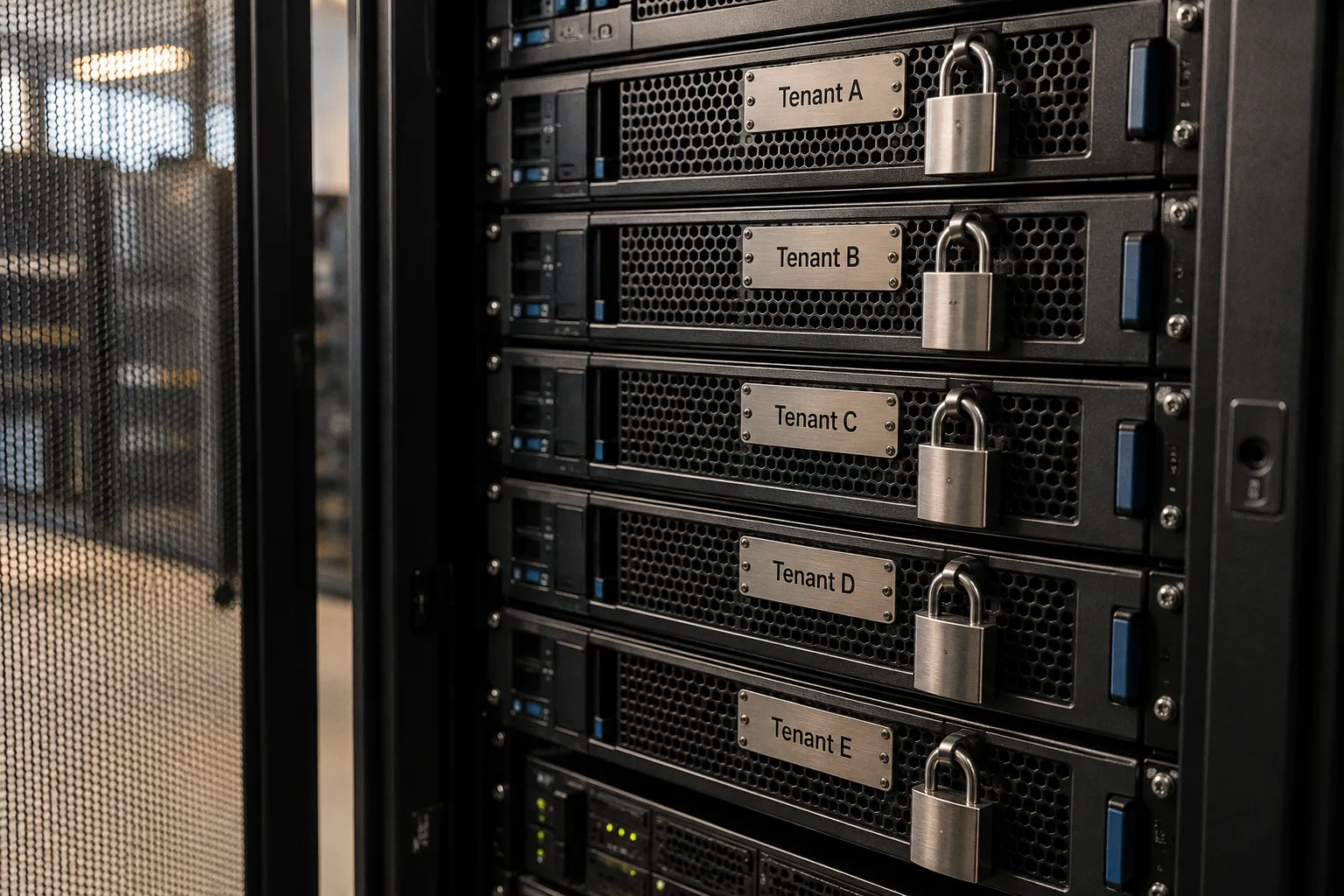
In practice, multi-tenant data isolation is not a binary choice between cheap pooling and expensive isolation. It is a set of design decisions about where tenant boundaries exist, how they are enforced, what happens when a query is wrong, and how much operational complexity the product can absorb. A custom SaaS application may begin with one relational database and a tenant_id column, then gradually introduce separate schemas, dedicated services, or fully isolated databases for selected customers.
The central question is not whether one model is universally superior. It is whether the chosen boundary matches the application’s risk profile, tenant distribution, compliance obligations, and expected growth.
For teams building custom web applications, these are the three foundational multi-tenant data isolation models in custom SaaS:
- Pool: shared database and shared schema.
- Bridge: shared database with a separate schema or selectively isolated components per tenant.
- Silo: a separate database instance for each tenant.
The terminology is useful because it describes more than database layout. It also captures the broader resource-sharing strategy of the SaaS platform.
The Pool Model: Shared Schema and Application-Level Security
The pool model places all tenants in the same database and uses the same tables. Each tenant-owned record carries a tenant identifier, typically a column such as tenant_id.
A simplified relational structure might include:
usersprojectsinvoicesdocumentsactivity_events
Each tenant-specific table contains a tenant identifier. A query for projects is not merely a request for project records. It must be scoped to the current tenant:
SELECT * FROM projects WHERE tenant_id =?
That design is conceptually straightforward and operationally efficient. The database has one schema to migrate, one set of indexes to monitor, and one backup strategy. A new customer does not require provisioning a new database or applying a schema template. In a low-friction onboarding flow, creating a tenant may be little more than inserting a row into a tenants table and associating the first administrator account with it.
This efficiency is the reason the pool model remains attractive for many SaaS products. It can support a large number of relatively small tenants without multiplying infrastructure. Storage, connection pools, monitoring, and deployment workflows are shared.
But the same density creates its defining weakness: the security boundary is easy to describe and easy to get subtly wrong.
A missing tenant filter is not a cosmetic defect. It can transform a normal application query into a cross-tenant data exposure. The error may sit in an export endpoint, an administrative report, a background job, or an infrequently used search path rather than in the main user interface. An application can appear correctly isolated during ordinary testing while failing on an edge case that bypasses the expected request context.
In a pooled SaaS database, tenant isolation is not a convention. It is a security boundary that must be enforced repeatedly and, where possible, below the application layer.
Why shared schema is operationally appealing
The pool model reduces several forms of operational duplication:
- One migration path applies to the entire customer base.
- Backups cover all tenants through the same database process.
- Connection management is concentrated rather than distributed across many instances.
- Reporting across tenants is technically simpler, provided access controls distinguish internal analytics from customer-facing data.
- New tenants can usually be provisioned without infrastructure automation.
This is especially helpful when the application has a relatively uniform data model. A client portal with users, documents, tasks, and messages may fit naturally into shared tables. A multi-tenant dashboard product with standardized entities may also benefit from a common schema because cross-tenant product analytics and aggregate reporting are easier to build.
The trade-off appears when tenant behavior becomes uneven. One customer may import millions of records, run expensive reports, or generate a large volume of events while smaller tenants remain quiet. Since the tenants share tables and often share compute resources, workload interference becomes a design concern. Indexes, query plans, connection limits, and background workers need to be designed around both average and unusually demanding tenants.
The limits of application-only isolation
Application-level filtering is often the first implementation because it is visible and familiar. The service layer retrieves the current tenant, adds a filter, and returns the result. The pattern can work, but its safety depends on every relevant code path preserving the invariant.
That includes:
- Direct CRUD operations.
- Bulk imports and exports.
- Background jobs.
- Scheduled reports.
- Search indexes.
- File metadata and object-storage references.
- Webhook handlers.
- Administrative support tools.
- Data repair scripts.
- Raw SQL used for performance-sensitive endpoints.
The problem is probabilistic rather than merely procedural. As an application grows, the number of places where tenant context can be lost increases. A new developer may add a query without knowing that the table is shared. A reporting endpoint may use a different repository abstraction. A queue worker may receive a record ID but not the tenant context that should constrain the lookup.
Strong engineering standards therefore treat tenant scope as part of the data access contract, not an optional condition added by convention. Entity identifiers may be globally unique, but uniqueness does not replace authorization. Knowing the ID of a document should not be sufficient to retrieve it.
The Bridge Model: Logical Segregation Through Database Schemas
The bridge model occupies the middle ground between a fully pooled system and a fully siloed one. In database terms, one common implementation uses a single database instance with a separate logical schema for each tenant.
Instead of placing every customer’s projects in one shared projects table, the system may expose tenant-specific namespaces such as:
tenant_a.projectstenant_b.projectstenant_c.projects
The database remains shared, but the tenant data is separated into distinct schema namespaces. This can make boundaries more visible and reduce the chance that an ordinary query accidentally scans every customer’s rows in a shared table.
The bridge pattern does not have to mean that every part of the application is isolated in exactly the same way. A platform might keep authentication, billing, and product configuration in pooled tables while placing highly sensitive business records in tenant-specific schemas. Another design may retain a shared database for most customers but move a small set of demanding or regulated tenants onto dedicated infrastructure.
This is where the bridge concept becomes broader than “schema per tenant.” It describes a hybrid architecture in which some resources are pooled and others are segregated.
What a separate schema actually changes
A schema boundary can improve organization and reduce accidental mixing, but it does not remove operational complexity. Every schema still needs to receive migrations. If the application has hundreds or thousands of tenant schemas, a routine change becomes an orchestration problem:
1. Create or prepare the migration for the new schema version.
2. Apply it to each tenant namespace.
3. Track failures and partial completion.
4. Make the application compatible with old and new versions during rollout.
5. Verify that indexes, constraints, and permissions were applied consistently.
A single shared schema generally has one migration target. A schema-per-tenant design has many logical targets inside one database. The database engine may still be shared, but the deployment system must reason about a fleet of schemas.
This distinction is easy to underestimate in early development. Provisioning a new schema can be simple. Updating every schema safely during a high-traffic deployment is a different problem.
When the bridge model is compelling
The bridge model is most interesting when the application needs more separation than a single pooled schema can comfortably provide, but a database per tenant would be excessive.
It can make sense when:
- Customers have meaningfully different data volumes.
- Some tenant data requires a clearer logical boundary.
- The product needs a migration path toward dedicated deployments.
- The platform has a mix of standard and high-value accounts.
- Internal services need to isolate selected domains without duplicating the entire stack.
- The business expects a moderate number of tenants rather than an extremely large population of tiny accounts.
The design can also support a tiered commercial architecture. Standard tenants may remain in a pooled environment, while enterprise tenants receive dedicated schemas or databases. That arrangement is not automatically secure or operationally sound, but it gives the product team more options than a single universal storage pattern.
Shared database, separate schema performance
Performance is often presented as a simple hierarchy: shared schema is fastest, separate schema is slower, and separate databases are slowest. Real systems are less predictable.
Query performance depends on indexes, data distribution, connection management, query plans, background workloads, and the database engine’s behavior. A separate schema does not guarantee better performance if all schemas compete for the same CPU, memory, storage, and connection capacity. Conversely, a well-indexed shared table can perform effectively for many tenants until data volume or workload skew changes the conditions.
The relevant question is not whether a schema boundary sounds more isolated. It is where contention occurs and whether the operational team can observe it.
The Silo Model: Physical Isolation for Enterprise Requirements
The silo model provisions a separate database instance for each tenant. The boundary is physical at the database level rather than merely logical inside shared tables or schemas.
This is the strongest of the three primary models in terms of direct data separation. A query issued against one tenant’s database does not ordinarily include another tenant’s tables because the other tenant is not present in that database instance.
That separation can be valuable for enterprise customers, regulated workloads, contractual commitments, and environments where tenant-specific backup, retention, or restoration policies matter. It can also simplify certain conversations with security reviewers: the architecture has a concrete database boundary instead of relying entirely on application logic or row-level policies.
But physical isolation does not mean operational simplicity. It multiplies the number of resources that must be managed.
For every tenant database, the platform may need to handle:
- Provisioning and deprovisioning.
- Credentials and secret rotation.
- Backups and restore testing.
- Monitoring and alerting.
- Patching.
- Schema migrations.
- Connection pools.
- Capacity planning.
- Disaster recovery.
- Data export and deletion.
- Tenant-specific diagnostics.
A database-per-tenant system can be an appropriate answer to a compliance requirement while still being a poor default for every customer. The infrastructure bill is only one part of the cost. The more serious expense may be the operational surface area: more resources, more state, more failure modes, and more automation required to keep the fleet consistent.
Silo does not eliminate application security
A dedicated database protects one tenant from another at the storage boundary, but the application can still connect to the wrong database, use the wrong credentials, expose the wrong customer’s records, or mishandle tenant routing.
A tenant-aware request still needs reliable identity, authorization, and routing. If a service chooses the database based on an untrusted parameter, physical separation will not correct the routing mistake. The silo model narrows one class of failure; it does not replace secure application design.
The same applies to shared infrastructure around the database. Search indexes, object storage, caches, logs, analytics systems, and message queues may remain pooled. The database can be isolated while a file download endpoint or cache key leaks data elsewhere.
A silo narrows the blast radius of a database mistake. It does not make tenant context disappear from the rest of the system.
The economics of dedicated databases
The silo model is most defensible when the cost of stronger separation is connected to a real business requirement. Enterprise pricing, regulated data, customer-specific recovery objectives, or contractual isolation terms may justify the added overhead.
It is less convincing when every low-volume tenant receives a dedicated database simply because physical separation sounds safer. For a platform with many small accounts, the model can create a large number of mostly idle resources and a migration fleet that grows faster than the product’s actual value.
The practical scale guideline is often expressed as a spectrum: silo architectures are associated with hundreds of tenants, bridge models with roughly thousands, and pool models with very large populations, potentially millions of tenants. These are not laws of physics. Tenant size, workload, service boundaries, and operational maturity matter more than a single count. A hundred enterprise tenants can generate more complexity than many thousands of lightweight accounts.
Enforcing Security with Row-Level Policies
Row-level security provides a database-level mechanism for enforcing tenant isolation in a shared-schema architecture. In PostgreSQL and similar relational environments, policies can constrain which rows a database role may read or modify.
A policy may compare the row’s tenant_id with a tenant value held in the database session, conceptually following a condition such as:
tenant_id = current_setting('app.tenant')::uuid
The application establishes the tenant context for the connection, and the database applies the policy when the query runs. This creates a second line of defense beneath application code.
That distinction matters. If a developer forgets a WHERE tenant_id =? condition, an effective row-level policy can still prevent unauthorized rows from being returned. RLS does not make a flawed system automatically secure, but it changes the failure mode. A missing filter becomes more likely to produce an authorization error or an empty result than a cross-tenant data set.
RLS requires disciplined connection handling
Row-level security depends on trustworthy session state. In a connection-pooled application, the tenant context must be set correctly whenever a connection is used and cleared or replaced before it is returned to the pool. A stale session setting can be dangerous if the next request reuses the connection under a different tenant.
The implementation therefore has to define:
- How tenant identity is derived from the authenticated request.
- Which database role can set the tenant context.
- Whether privileged roles bypass RLS.
- How background workers establish tenant scope.
- How transactions prevent context leakage.
- How migrations and maintenance tasks access all tenants.
- How tests verify denial as well as successful access.
This is an example of a recurring pattern in custom web application architecture: a security feature moves risk rather than erasing it. RLS reduces dependence on perfect query discipline, but it introduces a requirement for reliable database-session discipline.
RLS and privileged access
Administrative operations complicate the model. Support staff, analytics pipelines, migrations, and disaster-recovery procedures may need cross-tenant access. If these processes use a privileged database role that bypasses policies, the bypass must be deliberate and tightly controlled.
The system should distinguish customer-facing access from internal operations. A support tool that can inspect every tenant should not run with the same credentials as the normal application path. Otherwise, an accidental use of an administrative connection in a customer request can undermine the entire isolation strategy.
RLS is strongest when it is part of a layered design:
- Application authentication identifies the user.
- Authorization determines whether the user may act within the tenant.
- Tenant context is passed into the database.
- Database policies constrain row access.
- Logs record sensitive cross-tenant administrative actions.
- Tests attempt unauthorized reads and writes explicitly.
No single layer should be expected to carry the entire security argument.
Choosing a Model for a Custom SaaS Application
The decision becomes clearer when the architecture is evaluated against actual product conditions rather than abstract preference.
| Parameter | Pool model | Bridge model | Silo model |
|---|---|---|---|
| Database layout | Shared database and shared schema | Shared database with separate schemas or selectively isolated components | Separate database instance per tenant |
| Primary boundary | Tenant identifier and policy enforcement | Logical schema or hybrid resource boundary | Physical database boundary |
| Operational overhead | Lowest of the three | Moderate; migrations and provisioning multiply | Highest; resources and operations multiply per tenant |
| Typical strength | Cost-efficient, uniform SaaS workloads | Flexible separation for mixed tenant profiles | Strong isolation and tenant-specific compliance |
| Main risk | Missing filters or incorrect tenant context | Schema migration and lifecycle complexity | Fleet management, routing, and deployment consistency |
| Best fit | Large populations of relatively standardized tenants | Mixed workloads or gradual isolation strategy | Enterprise, regulated, or contractually dedicated tenants |
The table is not a procurement matrix. It is a way to expose the trade-off. The model that minimizes infrastructure duplication may increase the need for database-level controls. The model that maximizes isolation may create an operational system that is difficult to evolve.
Several questions usually reveal the right direction:
1. Are tenant workloads uniform?
If most customers have similar data volumes and request patterns, a pooled model is easier to justify. Severe workload asymmetry may support a bridge or selective silo strategy.
2. What does the contract require?
A customer may require logical isolation, dedicated resources, a specific backup arrangement, or evidence of a particular control. The architecture should respond to the actual obligation rather than to vague enterprise language.
3. How often will the schema change?
A rapidly evolving product may struggle with thousands of independent schemas or databases. Migration design can become the limiting factor before storage or compute does.
4. Which systems contain tenant data?
The relational database is only one part of the data plane. Search, files, caches, logs, event streams, and analytics need corresponding tenant boundaries.
5. How will a tenant be moved?
A mature architecture should be able to explain migration from pool to bridge, bridge to silo, or silo back to a shared environment. Tenant mobility is often more valuable than committing to one permanent model.
6. What happens during partial failure?
A pooled database outage may affect many customers at once. A silo outage may affect one tenant, but a deployment or control-plane failure can still affect the entire fleet.
Selective isolation is often more realistic than ideological purity
A custom SaaS application does not have to place every tenant in the same category forever. A platform can begin with pooled storage, add RLS, and later move selected customers to dedicated databases. The difficult part is not the diagram. It is building the control plane that knows where each tenant lives and routes requests accordingly.
That control plane needs authoritative tenant metadata, safe provisioning, migration tooling, health checks, credential management, and clear observability. If tenant location is scattered across configuration files and deployment scripts, selective isolation becomes fragile.
A hybrid system also needs consistent domain behavior. The application should not expose radically different semantics simply because one tenant is in a shared schema and another is in a dedicated database. Storage location may vary while the product contract remains stable.
Database size is not the only scaling limit
Cloud database services impose storage limits that may become relevant in a silo or bridge architecture. For commonly used managed engines, single-instance storage limits vary by engine: figures cited for Amazon RDS include up to 6 TB for MySQL, PostgreSQL, MariaDB, and Oracle, 4 TB for SQL Server, and 64 TB for Aurora.
Those limits are useful context, but they rarely decide the architecture alone. A tenant can encounter connection limits, I/O pressure, backup duration, replication lag, or migration windows long before reaching maximum storage. A shared system can also become difficult to operate because of noisy neighbors even when total capacity remains available.
Capacity planning should therefore consider the shape of use:
- Number of tenants.
- Number of active users per tenant.
- Peak concurrent connections.
- Read/write ratio.
- Largest tenant data volume.
- Background processing intensity.
- Reporting and export behavior.
- Backup and restore objectives.
- Migration duration at peak size.
There is no universal benchmark for the query overhead of a visual no-code engine compared with a native SQL implementation. That uncertainty is important for teams building custom applications on no-code or low-code platforms. The database model should be validated with representative workload tests rather than inferred from platform marketing or from the logical elegance of the schema.
Deployment Strategy Matters as Much as Data Layout
Multi-tenancy is often discussed as a database decision, but deployment architecture determines whether the chosen model remains manageable.
A pooled system may need fewer database migrations, yet it can require careful release sequencing because one schema change affects every tenant. A silo system may isolate runtime failures, yet it requires a migration coordinator capable of handling thousands of independent targets. A bridge system combines both concerns.
A reliable deployment process should make the following states visible:
- Tenants on the current schema version.
- Tenants awaiting migration.
- Tenants whose migration failed.
- Tenants temporarily running a compatibility path.
- Tenants with unusual data characteristics.
- Tenants scheduled for relocation.
The migration system should be idempotent where possible and designed for interruption. A deployment that assumes every tenant database is online, reachable, and equally fast will eventually fail in production. In a silo model, one unavailable database should not necessarily block the entire rollout. In a schema-per-tenant model, one malformed tenant schema should not leave the migration state ambiguous.
This is where the engineering distinction between architecture and operations becomes less useful. The isolation model is only as credible as the processes that maintain it.
A Reasoned Default for New Custom Web Apps
For many new custom SaaS products, a pooled database with explicit tenant identifiers and database-level enforcement is a reasonable starting point. It avoids premature infrastructure multiplication while leaving room for stronger controls through row-level security, scoped data access, and disciplined service boundaries.
That default should not be interpreted as permission to postpone isolation design. The following decisions belong near the beginning of the project:
- Which entities are tenant-owned.
- Which entities are global.
- How tenant context enters each request.
- How background jobs retain tenant scope.
- How files and caches are namespaced.
- Which database roles can bypass policies.
- How a tenant will be exported or deleted.
- How a tenant can be moved to more isolated infrastructure later.
If those questions remain implicit, migration to a bridge or silo architecture becomes much harder. If they are explicit, the initial pool model can be a deliberate stage rather than a permanent constraint.
The bridge model becomes attractive when the customer base is heterogeneous and the business needs a middle layer of isolation. The silo model becomes compelling when a customer’s contractual, regulatory, or operational requirements justify dedicated resources. Neither model is a badge of maturity by itself.
The Boundary Is a Product Decision
Multi-tenant data isolation is often framed as an infrastructure optimization. It is more accurately a product decision with engineering consequences.
A pooled architecture may allow the business to serve many smaller tenants economically, but it demands rigorous controls against cross-tenant access. A bridge architecture creates room for differentiated isolation, while introducing migration and lifecycle complexity. A silo architecture can satisfy demanding customers and reduce certain blast-radius concerns, but it turns every tenant into an operational unit.
The sound choice is the one the team can enforce, observe, migrate, and explain.
For a custom SaaS application, that usually means beginning with the simplest model that can meet the real security and compliance requirements, then designing the control plane so stronger isolation remains possible. In many systems, the future will not be purely pool, bridge, or silo. It will be a managed combination of all three, selected according to tenant needs.
The unresolved question is not whether multi-tenant platforms will become more isolated. It is whether their deployment and database tooling will become sufficiently mature to make that isolation affordable without turning every new customer into a separate operational project.