You know that feeling when you’re sitting in a planning meeting, and someone proposes an app that sounds like it belongs in a science fiction show? “It should sync across all devices, predict what the user needs, and automate half the workflow.” The room falls silent. Everyone looks at the developers, who start talking about complex integrations, massive budgets, and timelines that stretch into the next fiscal year. The dream feels out of reach.
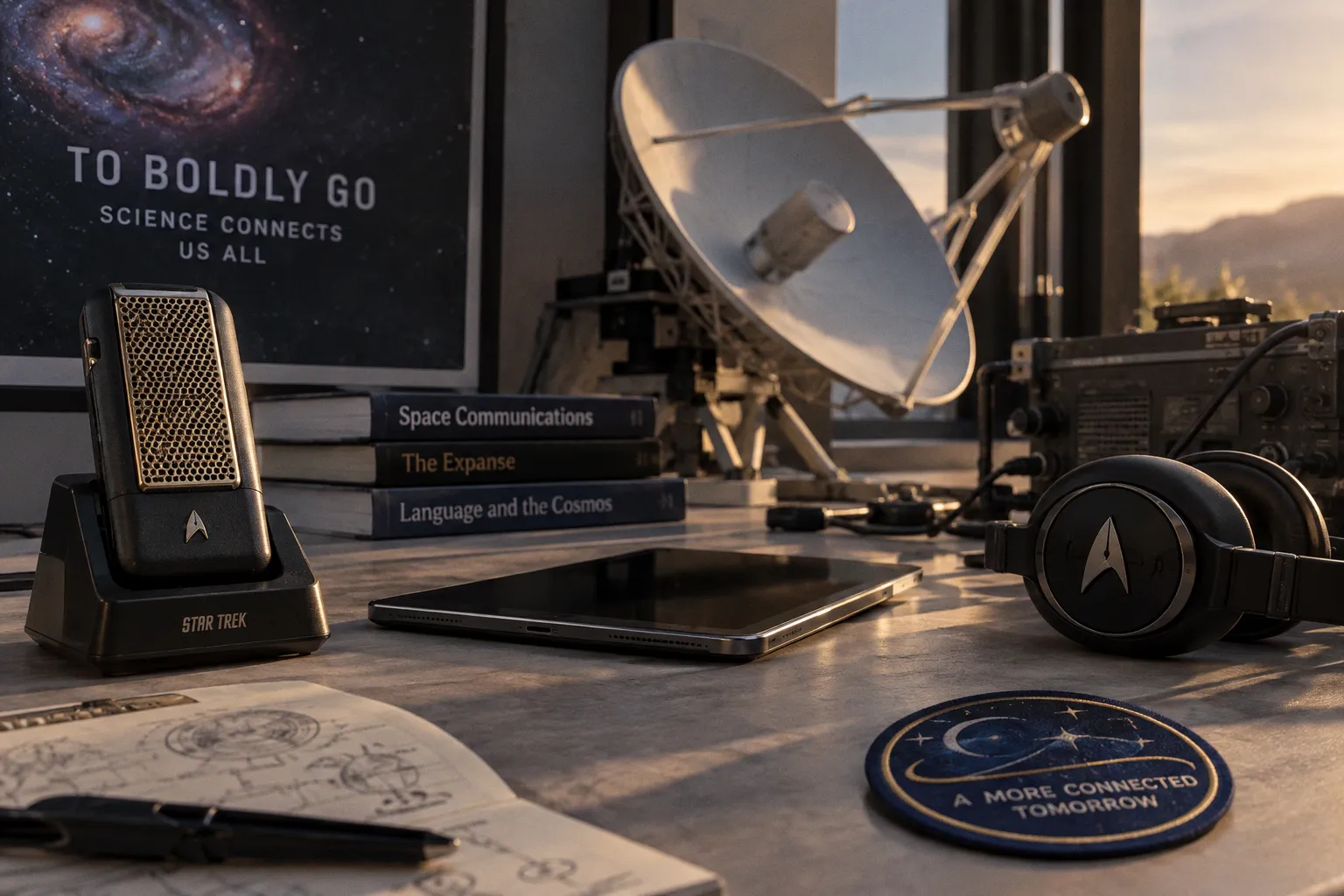
Now, picture an astronaut aboard the International Space Station, wearing a badge from a fictional starship captain to celebrate sixty years of Star Trek. As reported by Ars Technica, Sophie Adenot of the European Space Agency wore the Delta badge of Captain Pike while discussing how exploration and science are about curiosity and cooperation. “Science fiction imagines the future. We build it,” the accompanying post stated. This single, elegant line is the bridge between a fantastical idea and a tangible project. It’s a principle that directly applies to the way we approach building custom software today.
From Fiction to Functional Blueprint
For decades, Star Trek showcased technologies that felt impossibly advanced: handheld communicators, medical tricorders, and computer interfaces that responded to natural commands. These weren’t just storytelling props; they were imaginative blueprints. Engineers and scientists saw them as a challenge. As the ESA noted, the mission hasn’t changed—explore, discover, and do it together. This mindset is exactly what a non-technical team leader needs when facing a complex operational problem. The “fiction” is the initial concept for a better workflow. The “build” phase is where the strategy comes in.
You don’t need a team of Starfleet engineers to turn your department’s “what if” into a “why not.” Modern visual development platforms are the replicators of the business world. They take an abstract idea—a system to manage client onboarding, a dashboard that pulls data from three different sources, an internal tool for tracking project milestones—and allow you to assemble it piece by piece, visually. The recent education pilot highlighted by The Rockefeller Foundation, where students built full-featured apps without writing code, demonstrates this perfectly. They weren’t just learning to code; they were learning to translate imagination into functional reality, a skill any department can leverage.
Assembling Your Own Starship
The journey from idea to deployed application doesn’t require a quantum leap. It starts with a single, practical step: mapping the core pain point. Think of it as your mission briefing. What is the one process that, if it were 50% more efficient, would transform your team’s week? Is it the manual data entry that bridges two software systems? The clunky approval chain that requires three emails and a signature? Define that single friction point. This is your “boldly going” moment.
Next, consider your crew and your tools. A visual builder platform acts as your universal translator, turning your operational needs into a logical sequence of steps. You’ll drag and drop components for user inputs, database connections, and automated actions. You’ll set the “rules of engagement” for your data—what happens when a form is submitted, when a deadline approaches, when a metric hits a certain threshold. This is the cooperative building the ESA mentioned. You, the domain expert, provide the mission parameters. The platform provides the compliant, no-code environment to construct the solution. The result isn’t a generic off-the-shelf tool; it’s your custom system, built for your specific voyage.
Charting the Course for What’s Next
The lesson from sixty years of Star Trek isn’t just about the technology itself; it’s about the ethos of making the imagined accessible. We’re seeing this play out in real-time in education and business software. The tools are becoming more intuitive, the platforms more powerful, and the barrier to entry lower than ever.
Your next step isn’t to commission a multi-year, multi-million-dollar project. It’s to isolate that one operational headache your team faces. Sketch it on a whiteboard. Ask, “If we could wave a magic wand and have a perfect tool for this, what would it look like?” Then, investigate how a visual development platform can turn that sketch into a working prototype. The future of your workflow is probably less of a distant nebula and more of a nearby, buildable planet than you think. Live long and prosper in your next project.